WHO WE ARE:
Showing posts with label TRICARE. Show all posts
Tuesday, September 18, 2012
“Finish Strong:” Highlights from Connecticut Delegation Meetings
VFW National Legislative Committee members Bob Hunter from Connecticut and Christian Kulikoski from Massachusetts met with Rep. John Larson, D-Conn., Rep. Chris Murphy, D-Conn., Rep. Rosa DeLauro, D-Conn., Sen. Richard Blumenthal, D-Conn., and Sen. Joseph Lieberman, I-Conn., as part of last week’s Capitol Hill visits, telling the 112th Congress to “Finish Strong For Veterans.”
Hunter and Kulikoski spent the day highlighting the VFW's priorities and outstanding issues to members of the Connecticut congressional delegation. Kulikoski, who also serves as a Massachusetts VFW Department Service Officer, was well-versed in health care and benefits delivery, and highlighted the hot-button issues such as stopping DoD efforts to increase TRICARE fees and copays, ensuring the successful implementation of the Veterans Benefit Management System, or VBMS, and providing more resources to deliver educational benefits.
Hunter, who serves as the VFW Legislative Chairman for Connecticut, punctuated the issues by highlighting DoD's reallocation of nearly three billion dollars over the past three years from TRICARE to fund other DoD programs. He also encouraged his members on Congress to seriously consider giving VA the tools to continuously improve their business processes, while dealing with the disability claims backlog. Both committee members discussed the alarming 18-percent rise in veteran suicides over the past year, and all members of the Connecticut delegation agreed more effort must be directed to curbing the losses of our comrades when they return home.
Hunter also discussed VFW’s progress locally, seeking to shut down predatory non-profit organizations claiming to serve veterans. The VFW in Connecticut learned that one such organization was doing little more than raising money for their benefit, while only disbursing meager amounts of aide to veterans in need.
Blumenthal, who is working closely with the VFW Department of Connecticut to spearhead this fight, let Hunter know that VA has begun to aggressively reassess those organizations listed as “trusted entities” providing additional help and services to veterans. He went on to say that the organization in question has since been removed from VA's list of trusted organizations.
Last week, VFW advocates were out in force on Capitol Hill, meeting with nearly every Congressional office, highlighting VFW’s outstanding issues for the 112th Congress. To learn more about the VFW’s priorities from last week’s legislative visits, click here, and check back regularly for highlights of how our advocates told Congress to “Finish Strong For Veterans.”
(Image: Top: VFW Legislative Committee members Bob Hunter, left, and Christian Kulikoski, right, meet with Rep. John Larson, D-Conn., during last week's legislative conference. Bottom: Hunter and his wife, Lynn, meet with Rep. Chris Murphy, D-Conn. Photos courtesy of Bob Hunter.)
Labels:
Capitol Hill,
Connecticut,
education,
Finish Strong For Veterans,
Massachusetts,
military,
student-veterans,
TRICARE,
VA,
VBMS,
veterans,
VFW
Tuesday, September 11, 2012
VFW Joins House VA Committee Republican Roundtable
House Veterans Affairs Committee Chairman Jeff Miller, R-Fla., hosted a roundtable discussion this morning with Republican committee leadership and leading veterans’ advocates in the committee’s chambers of the Cannon House Office Building. VFW Deputy Legislative Director Ryan Gallucci was on hand to discuss a series of persistent veterans’ issues like mental health care, employment, and looming budget concerns.
Miller decided to host the roundtable as a way to evaluate progress over the 112th Congress, identify shortfalls in meeting the needs of veterans, and candidly discussing potential new ideas to ensure veterans receive the care and benefits to which they are entitled.
The morning’s discussion took place just as the VFW National Legislative Committee converged on Washington, asking Congress to “Finish Strong For Veterans,” by enacting meaningful legislation, providing oversight, and applying pressure on federal agencies to better serve the veterans’ community. This week, VFW advocates will visit every Congressional office discuss VFW’s outstanding issues for the 112th Congress relating to benefits delivery, health care, budget concerns, and education and employment. To learn more about these issues, click here.
Gallucci reiterated the VFW’s “Finish Strong For Veterans” message, encouraging Congress to pass bills like the H.R. 4057 to improve consumer information for student-veterans; provide oversight to ensure the military’s new transition assistance program, or TAP, provides relevant resources to transitioning service members; ensure VA can meet its mental health staffing requirements; and apply pressure to VA and the Administration to define “administrative accounts” potentially affected by mandatory sequestration budget cuts.
Chairman Miller also took the opportunity to candidly discuss a controversial proposal from Republican leaders designed to help veterans receive timely mental health care from TRICARE providers, paid for by VA. The idea comes on the heels of ongoing military and veteran suicide concerns, and reports that VA cannot meet the demand to deliver mental health care in a timely manner.
Veterans’ advocates expressed concern about how the proposal could not only increase care costs for VA, but could create more bureaucratic problems for veterans seeking care outside the VA system.
Gallucci explained that many times veterans cannot receive timely mental health care from VA because they never actively enrolled in the VA health care system before reaching out for help. If veterans sought out emergency care from TRICARE providers on the economy, Gallucci explained that they could be left with a hefty bill for services, and face additional bureaucratic hurdles when they seek reimbursement from VA.
Chairman Miller explained that the concept was designed to ensure veterans who need mental health care can find somewhere to go as a stop-gap measure, and ensured the veterans’ community that his committee would flesh out exactly how such a system could efficiently deliver care.
Other discussion topics this morning included alternative treatments for traumatic brain injury like hypobaric oxygen therapy, persistent processing delays for Post-9/11 G.I. Bill recipients, the effectiveness of peer-to-peer counseling for mental health issues, and empowering employers to find potential veteran employees.
(Image: VFW Deputy Legislative Director Ryan Gallucci discusses VFW's call for Congress to "Finish Strong For Veterans" in the 112th Congress. Photo courtesy of the House Committee on Veterans Affairs.)
Friday, August 10, 2012
Post Reports That Pentagon Fudged TRICARE Numbers
The Washington Post reported this week that the Department of Defense has requested nearly $3 billion over the last three years be moved from funds dedicated to TRICARE into weapons programs and other accounts unrelated to healthcare, despite assurances from Pentagon officials that healthcare costs were "eating the U.S. military alive."
According to a report on the FY2013 Defense Appropriations Act provided by the Senate Appropriations Subcommittee on Defense, the Pentagon reprogrammed $1.36 billion dollars from TRICARE in fiscal year 2011, $772 million in fiscal year 2010, and requested an additional $708 million to reprogram from this year's budget.
This reprogramming has been happening at a time that the VFW has worked tirelessly to prevent the Pentagon from arbitrarily raising TRICARE copayments, adding and expanding fees, and tying increases to medical inflation; while retiree health costs are rising at an average rate of 2.6 percent.
"The VFW is adamant that the Pentagon must not be allowed to pull this bait-and-switch on Congress and TRICARE beneficiaries," said VFW Executive Director Bob Wallace. "Instead, the Pentagon must improve its budget and management controls so Congress can have an accurate view of the fiscal situation within TRICARE and the entire Military Health System before shifting responsibility to those who choose to wear the uniform to pay for their own health care."
Your VFW has been one of the few veterans' organizations in Washington fighting to prevent any increases in military health care premiums, encouraging Washington bureaucrats to do the hard work of generating a more cost-effective military, without jeopardizing the welfare of military families and breaking faith with military retirees.
VFW advocacy efforts earlier this year successfully fought off TRICARE fee increases, and in light of this recent report, the VFW intends only to ratchet up the pressure.
To make your voice heard on TRICARE fees, click here, and check back regularly with this blog for updates.
To read the full Senate report, click here. Details on health care reprogramming can be found on p. 228.
Friday, July 13, 2012
VFW Reacts to Survey on Military Compensation
Yesterday morning the VFW was on hand at the National Press Club where the Center for Strategic and Budgetary Assessments, or CSBA, unveiled its report from a recent survey of service members, veterans, military families and retirees on military compensation.
When CSBA announced the survey in January, the VFW was harshly critical of the content and potential outcomes. Yesterday, CSBA Senior Fellow Todd Harrison, the architect of the survey, sought to quash some of the criticism, making his case for why the Pentagon should conduct its own similar surveys before deciding how it plans to alter military pay and benefits programs, updating the surveys periodically in an effort to optimize its compensation packages.
In his remarks, Harrison was careful to point out that CSBA’s report only demonstrated how service members perceived the value of the benefits they currently receive, and that the report should not be misconstrued as recommending any specific policy changes. He went on to criticize the Pentagon for its current approach to changing the military benefits structure, warning that proposals to strictly cut certain benefits without planning to enhance others, would prove detrimental to the quality of the force.
In the wake of yesterday's announcement, VFW leaders said that they understand the purpose of this study, but the organization remains concerned about how the Pentagon will interpret the results. In its report, CSBA pointed out that decisions about optimization should not be made solely based on perceptions of the force, but that policy makers must consider factors like fairness, equity, feasibility, and operational impact before making any changes. The VFW reiterated this sentiment in its reaction.
“It’s our duty as veterans’ advocates to ensure that the Pentagon considers the broader implications of changing its benefits system for the sake of not only recruiting and retaining competent professional leaders, but also ensuring the overall physical and financial well-being of the those who volunteer to serve,” said VFW Deputy Legislative Director Ryan Gallucci, who was on hand for the announcement. “Saving defense dollars is secondary to looking out for our troops and their families, and to preserving the integrity of an all-volunteer, professionally-led force.”
CSBA aggregated the data it compiled from more than 2,600 participants according to time-in-service, rank, branch and marital status in an effort to better analyze the data for different cohorts, both career and non-career, demonstrating how each group valued benefits differently.
Through the survey, CSBA discovered that many immediate tangible benefits, like increased base pay, increased leave, choice of duty station or access to exchange services, were perceived as highly valuable to service members across the ranks relative to actual cost. However, long term or contingency benefits like health care or retirement, were undervalued by potential beneficiaries relative to actual cost.
The VFW was not surprised by these findings, as similar surveys in the private sector indicate that civilian employees consistently convey similar misconceptions about their benefits packages. When employees undervalue some of their most lucrative benefits, companies can then justify hollowing out benefit programs under the guise of optimization.
“The Pentagon may want to optimize military benefits packages to simultaneously save money and boost perceived value among the troops, but the VFW is not concerned about perceptions,” said Gallucci. “We’re concerned about protecting our troops and demonstrating the actual value of their earned benefits.”
To read the full CSBA report, click here.
Your VFW has been one of the most vocal opponents of changes to military benefits and quality-of-life programs, exposing ten proposed cuts designed to pay for ten years of war through last year’s “10 for 10” campaign.
VFW advocates from coast to coast have consistently banded together to stop these kinds of toxic proposals whenever they surface, and we will continue to hold defense officials accountable for their decisions on the welfare of the all-volunteer force. Check back regularly with this blog for updates.
(Image: CSBA Senior Fellow Todd Harrison explains how the military envisioned its all-volunteer force in the 1970s during yesterday's announcement of CSBA's report on military compensation. Photo by Ryan Gallucci.)
Tuesday, June 5, 2012
An Advocate’s Point of View by Retired Navy Petty Officer Hal Cleveland
Earlier this spring, we introduced several VFW members who shared their stories of advocacy leading up to the spring legislative conference in Washington, D.C. As we continue to hear how VFW members advocate on behalf of their fellow veterans, we want to continue sharing their stories. This week, retired Navy Petty Officer Hal Cleveland tells us why he advocates for veterans and how he recently mobilized his fellow VFW members to tell Congress to protect military retirees and their earned health care benefits.
I have been advocating for veterans since I retired from the U.S. Navy in 1993. From my first involvement with the various veterans’ service organizations I belong to, I have been promoting and communicating legislative actions and news about veterans to anyone that will listen.
I have used the internet to scout for veterans who are willing to use the CapWiz prewritten emails to write our elected members in Washington. However, I realized that a letter here or there was not getting the message across, so I decided to concentrate on my local VFW post, VFW district commander, as well as all veterans who were willing to sign up with me in the congressional district where I live. My reasoning for this was that the more letters a representative or senators receives, the better chance that he or she would take notice of our issues – the squeaky wheel gets the grease theory. Everyone knows that not all the letters get read, but they do get counted and are categorized by subject, so if there was someone in every congressional district in the country that was a VFW legislative advocate, we could make our voices heard!
There is a thin line between advocating for veterans benefits and being political, and many veterans do not know where that line is. I have lived by an old saying of “all politics are local.”
I developed email groups of the various service organizations I belong to, and I am the service officer for my local VFW post. It is a small post and most, if not all, of the members do not require my services as a service officer. This is why I tend to embrace the legislative aspect. I find that there are more non-members who approach me about benefits than members. However, I do enlist the membership’s help in getting Congress to keep or improve what benefits that other veterans have earned.
Last month, the post purchased envelopes, labels and stamps, and I printed out more than 60 letters addressing our congressional representative and senators to stop the unfair increases in TRICARE [premiums]. I can’t say for certain that it worked, but the VFW [Washington] Weekly newsletter I received today states that the Senate Armed Service Committee voted to not allow the increases to TRICARE premiums. At the same time, we sent letters to the House Armed Services Committee and they also chose to not accept the premium increases.
There is a good saying that says, “If you don’t tell Congress otherwise, they will think everything is ok.”
The biggest obstacle that I have to overcome is that to me, it appears that most veterans are usually their own worst enemy. When something is hot and moving in Washington, I will ask a veteran to write in support of a given subject and their answer is always, “that does not affect me; why should I write?” Or, they will try and tie a political party to it. Regardless, you should hear them scream when they have an iron in the fire that they are interested in. Bottom line, if everyone would participate and if everyone sent one letter per week, we would speak with one loud and consistent voice.
I canvas all the legislative updates that I get from the various email subscriptions including the VFW and monthly I will post a legislative newsletter with a summarized version of what I have read. Not everyone responds by sending letters to their representative or their senators, but if they read it, they are more knowledgeable than the average person. Knowledge is a powerful tool, if they use it.
Twice a year we host a community service safety project, which I am chairman of this year, that serves free coffee and lemonade to the traveling public over the Memorial Day and Labor Day weekends. This gives me an opportunity to meet with comrades from other posts and also traveling veterans where I offer [our] newsletters to help educate them.
So there you have it. This is my input for suggestions on how I advocate for veterans. Thanks for the opportunity to share it with you.
Hal Cleveland retired from the U.S. Navy as a petty officer first class in 1993. During his time in the Navy, he deployed as an aviation maintenance administrationman in support of operations in Lebanon, Operation Urgent Fury in Grenada, and Operation Desert Storm in the Persian Gulf. Today, Hal continues to serve his fellow veterans as post service officer for Tri-Cities VFW Post 6872 in Crowley, Texas. To learn more about his post, click here. Photo courtesy of Hal Cleveland.
To submit an Advocate's Point of View or a Field Report for consideration on the VFW’s Capitol Hill blog, simply fill out our online form here, or send photos and stories directly to vfwac@vfw.org.
Tuesday, February 21, 2012
VFW Takes the Hill: An Advocate’s Point of View from Navy veteran Jim Ellars
In two weeks VFW leaders from around the country and around the world will converge on Washington, D.C., to meet with every Congressional office ahead of VFW Commander-in-Chief Richard L. DeNoyer’s testimony before a special joint session of the House and Senate Veterans Affairs Committees. In advance of the conference, which will bring in advocates from the VFW’s legislative, women veterans, and Iraq/Afghanistan-era veterans committees, the VFW Washington office has asked some of our advocates to explain why the annual Capitol Hill visits are important and why they chose to become involved in veterans advocacy. Be on the look-out for more personal stories like this leading up to the convention. Below is our first submission from Department of Arizona Legislative Officer and Navy veteran Jim Ellars:
We all made a difference, being in the military and having spent a part of our lives “answering the call,” and while we all still want to make a difference, nowadays we just don't always know how to pull it off. I found a way, and I believe you would like to join in. I became a veterans advocate. How? Pretty simple, really. I showed up and spoke up. It was that simple, and certainly not hard for a military man or woman to do.
Our federal, state and local governments provide numerous opportunities for people to attend forums and meetings to voice concerns and offer assistance for a multitude of issues. Being like you and still wanting to make a difference, I attended one such meeting along with district members of the VFW. It turned out to be the first of many meetings I would attend, and over time I found that those meetings, peopled by others just like me, created that difference I was looking for. Happily, I saw changes came out of these meetings; changes to the very laws that affected the people at my post, the people on the [military] bases I visited, and to the families I saw at the commissary and exchange; every one of them. It was an enormous and powerful realization, so I stuck with it, and the next thing I knew, I was another veterans advocate. And the more I stuck with it, the more I saw positive changes being made.
“But, Jim, does advocacy really work?”
Over the past few years I've “stormed the Hill” with those same “others like me,” and along the way I got to know the people and the processes of [Capitol] Hill.
Back in November, the VFW National Legislative Office in [Washington] D.C. – an exceptionally dedicated group of people devoted to monitoring the complex legislative world of D.C. for our military, our veterans, and their families – alerted the members of the VFW to a harmful proposal being considered for pending legislation that adversely affected TRICARE fees. There was an immediate need for a grassroots effort from all veterans to vote the proposal down. Arizona has a large population of retired military personnel and a number of major military bases. As a VFW advocate, I immediately used my experience on the Hill and contacted key Senate staff that I had met in D.C., and also spoke to our department's leadership at a VFW Ladies Auxiliary training conference.
The department and Ladies Auxiliary members responded immediately by initiating a campaign to contact the Senate, particularly the proposal's sponsor, to demand the proposal be voted down. This action was repeated by all respective VFW advocates, the national [veterans service organizations], and many military/veteran associations. The sponsor listened. The proposal was withdrawn. This is just one example of VFW advocacy at work, one that is repeated all the time.
We're already a part of the world's most influential veterans organization that does great things for our military, our veterans, and their families. Take it to the next level: advocate for it! Go to www.vfw.org, click on VFW in DC and continue the mission!
Jim Ellars is a retired naval aircrewman who served on the USS Kitty Hawk and logged more than 4,000 hours on the flight line throughout his military career, earning his eligibility to join the VFW while deployed to Lebanon. Today Ellars is a member of the VFW National Legislative Committee and he continues to serve as the national legislative officer for the VFW Department of Arizona.
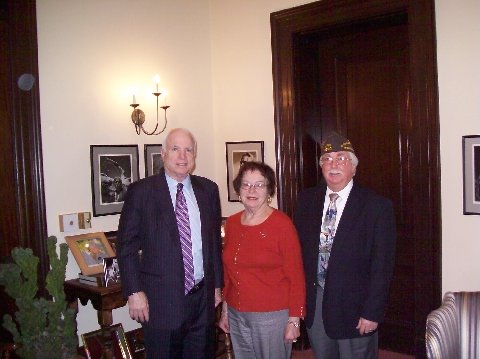
(Images: Top: VFW advocate Jim Ellars discusses the contentious TRICARE legislative issue at the VFW Department of Arizona Ladies Auxiliary training conference in November 2011. Bottom: Sen. John McCain, R-Ariz., meets with Blue Star mother Francis Playfoot and Ellars in Washington, D.C., during last year's VFW visits to Capitol Hill. Photos courtesy of Jim Ellars.)
Labels:
Action Corps,
advocacy,
Arizona,
Capitol Hill,
Jim Ellers,
John McCain,
Richard Denoyer,
TRICARE,
veterans,
VFW,
VFW Takes the Hill
Tuesday, February 14, 2012
VFW Mobilizes to Fight Defense Budget Proposals
The Pentagon unveiled its budget proposal for fiscal year 2013 this week, drawing criticism from the VFW for several proposals potentially hurting military personnel and retirees.
In a statement this afternoon, the VFW balked at Pentagon recommendations to create tiered systems for retirees participating in TRICARE, as well as new pharmaceutical copayments for military dependents and retirees, calling the ideas “deal breakers.” These latest proposals come on the heels of new fee increases tied to annual cost-of-living adjustments approved by Congress just last year.
“We will not allow the nation’s economic problems drive a military downsizing strategy that breaks faith with every man and woman who has ever worn the uniform,” said VFW Commander-in-Chief Richard L. DeNoyer. “We will not allow the budget crisis to be more important that the men and women who serve and sacrifice to keep everything and everyone we hold dear safe.”
The VFW has been the most vocal opponent of proposed TRICARE and pharmaceutical increases since exposing the ideas as part of last summer’s “10 for 10” campaign, and DeNoyer said the VFW plans to vocally oppose these new proposals, mobilizing its grassroots Action Corps against these new increases.
VFW is calling on its members and advocates from coast to coast to reach out to their members of Congress, asking them to oppose increases in health care fees on military retirees and military families. VFW leaders have consistently said that such proposals break the nation’s promise to care for the men and women who defend our nation and their loved ones. To read the full Action Alert, or sign up to join the Action Corps, click here.
“So few Americans serve in the military, and far fewer serve a full career in the military, making these brave few an easy target for some in Washington now that the wars are no longer front-page news,” said VFW National Legislative Director Ray Kelley. “Our military retirees and our military families have earned these benefits through their sustained sacrifices, which is why it is our obligation as veterans’ advocates to stand shoulder-to-shoulder with them to maintain the integrity of the system.”
The VFW offers resources to help you contact your legislators by clicking here.
Earlier this week, DeNoyer and the VFW praised the proposed increases in the VA budget, but cautioned that Defense cuts and lack of proper investment across VA could hurt the agency’s ability to care for today’s veterans.
“The VFW appreciates the proposed increase because it recognizes that the proper care and treatment of wounded, ill and injured veterans are ongoing costs of war," said DeNoyer. “We remain concerned, however, that the amount is not enough for the VA to maintain much less improve all the programs and services on their watch, especially knowing the Defense Department plans to shrink the size of the military, which will directly increase the number of veterans seeking VA care and services.”
The VFW will testify alongside partners in the Independent Budget before the House Veterans Affairs Committee tomorrow, outlining how the veterans’ community believes the VA should be funded in FY 2013. The Independent Budget is a roadmap for funding veterans’ programs compiled by AMVETS, Disabled American Veterans, Paralyzed Veterans of America and the VFW that Congress has used for more than a quarter century to help guide the VA budget process. Details on the hearing can be found here, and check back with this blog tomorrow morning to watch live.
We want to hear your thoughts on this week’s budget proposals for both VA and DoD. Please leave your comments below and check back throughout this week for updates.
Friday, January 27, 2012
VFW Reacts to Pentagon Budget Priorities
Defense Secretary Leon E. Panetta unveiled the Pentagon’s budget priorities this week for fiscal year 2013, reflecting the Administration’s calls for a leaner, more agile force as the conflicts in Iraq and Afghanistan wind down. In light of pledges from the Pentagon to ensure that the U.S. military remains a lethal and effective force, VFW leaders voiced their concerns over proposed cuts that could dilute the quality of America’s military and possibly threaten the continued viability of the all-volunteer force.
The Defense Department is expected to request $525 billion as a baseline budget for FY2013, with an additional $88.4 billion for overseas contingencies; $6 billion and $27 billion less, respectively, than FY 2012. Five key strategies for DoD include driving the future military force, which will be smaller and leaner; repositioning with more emphasis on Asia-Pacific and the Middle East; strengthening through better alliances and partnerships; and developing an extremely agile and deadly force, which will be second-to-none in technology and capability.
Some key priorities and choices that could be made over the next five years include:
• To reduce the active Army from 570,000 to 490,000 soldiers, and the active Marine Corps from 202,000 to 182,000.In response to the announcement, VFW leaders said they continue to be wary of plans to change the current military retirement system and potentially saddle military retirees with higher health care costs.
• To reduce the number of Air Force tactical air squadrons from 60 to 54, but maintain the current bomber fleet, as well as the Navy’s 11 aircraft carriers, 10 air wings and big-deck amphibious fleet.
• To fund a new bomber, increase cruise missile capacity in future Virginia-class submarines, and increase investments in cyber capabilities, special operations, homeland missile defense, countering weapons of mass destruction, and projecting power into denied areas.
• To provide service members full pay raises in 2013 and 2014, but begin limiting increases starting in 2015.
• To ask Congress to conduct a comprehensive review of the military retirement system, while grandfathering all current retirees and service members into the existing system.
• To recommend increases in healthcare fees, co-pays and deductibles for military retirees using a tiered approach, based on their retired pay, as well as create a TRICARE for Life enrollment fee for retirees age 65 and older. Exempt would be medical retirees and survivors of those who died on active duty.
“We are pleased to continually hear pledges from the White House and Pentagon that retirees and those serving in uniform today will be grandfathered under the old system, but our concern is for tomorrow's recruit,” said VFW Executive Director Bob Wallace. “Asking someone to first donate 20 or more years of their youth in return for the immediate receipt of a modest retirement pay is a contract, which cannot be compared with any civilian occupation or retirement plan. We are concerned, however, that by introducing civilian retirement plans into a military world it has zero in common with, could signal the end of the all-volunteer force. A lot of trial balloons have been floated, so we have to wait for details.”
Traditionally, only eight percent of America’s military men and women serve until retirement age. With already low retention of career service members, the VFW is concerned that too many new proposed incentives for highly-trained and highly-qualified leaders to leave the military early could thin the force to such an extent that the last person standing, not the best qualified, could serve as the next service chief or senior enlisted leader. Plus, too many incentives to leave could also mean a watered down G.I. Bill for veterans.
VFW leaders went on to say that increasing enrollment fees and copayments while reducing services for retirees is a breach of faith with all who choose to serve; a sentiment the VFW has consistently voiced since launching the “10 for 10” campaign against military and veterans’ benefits cuts last summer.
When discussions of an overhaul to the military retirement first surfaced, the VFW polled readers on this blog about their inclinations to serve a full career with watered-down retirement benefits. The results, which can be viewed here, indicated to VFW leaders that such changes would threaten the continued viability of the all-volunteer force by incentivizing the best and brightest to leave early in their military careers.
Your VFW will continue to fight against these proposals, ensuring that America’s military remains strong and sustainable for future generations. Keep posted to this blog for updates.
(Image: Defense Secretary Leon E. Panetta and Army Gen. Martin E. Dempsey, chairman of the Joint Chiefs of Staff, brief the press on major budget decisions stemming from the defense strategic guidance at the Pentagon, Jan. 26, 2012. DoD photo by U.S. Navy Petty Officer 1st Class Chad J. McNeeley.)
Monday, January 9, 2012
We’re Back, and Looking for Your Stories in the New Year
With Congress still on recess, the work hasn’t stopped for the VFW’s office on Capitol Hill. This week, we returned from the New Years break and hit the ground running to promote the VFW’s legislative priority goals in anticipation of the second session of the 112th Congress.
With almost 470 representatives and senators up for reelection this November, now is the perfect time to reach out to them in their home districts and educate them on issues critical to the veterans’ community. With this in mind, the VFW’s Capitol Hill blog would like to hear from you as you interact with your elected officials to promote the VFW’s legislative priority goals, and to discuss military and veterans’ issues.
Whether you’re meeting face-to-face, attending events, hosting town hall meetings, or attending forums in your area, please send us your photos and information on these events, such as “who, what, when, where and why” for consideration to be published on the blog. We are not looking for photos from political rallies or campaign work; we are looking to highlight the work of the VFW to inform those serving in public office about veterans’ issues.
Our blog has the ability to reach more than 2 million members of the VFW, and thousands more veterans’ advocates, all of whom are interested in making a difference for veterans. However, our voice on Capitol Hill is only as strong as the voice of VFW advocates in Congressional districts across the country. We designed this blog to help share your stories, as well, making sure that we reach our members of Congress and ensure they make the right decisions when it comes to our service members, veterans and their families.
Thanks to the work of our advocates in 2011, we successfully passed comprehensive veterans’ employment legislation with the VOW to Hire Heroes Act, and protected key benefits like TRICARE for Life and presumptive service connected conditions. We also sent a stern message to Congress that we will protect military and veterans’ benefits at all costs with the roll-out of the “10 for 10” campaign. In 2012, we hope to build on these successes, and we hope you will join us in that mission.
To share your photos and stories, submit them electronically to vfwac@vfw.org, and continue to follow this blog, highlighting our day-to-day work protecting our service members, veterans and their loved ones.
Subscribe to:
Posts (Atom)